
Audi Q5 EGR delete
If your Q5 has gone into limp mode with P0401 or P0403 in the fault log, the EGR is almost certainly the culprit. These are the two most common codes on the Q5 diesel range, and they point directly to EGR flow restriction or valve circuit failure. We carry out a complete software-based EGR delete via ECU remap, no physical work, no downtime beyond the remap session itself.
£220. Mobile. We come to you.
Important: EGR delete is for off-road and track use only and must not be used on UK public roads. All work carried out by The EGR Specialist is for motorsport and off-road applications exclusively.
Fault codes first: what the Q5 tells you
Most Q5 owners arrive at an EGR delete after a visit to a dealer or independent garage that pulls one or more of the following codes:
These codes are often accompanied by a yellow engine management light, hesitation at low revs, rough idle, and in the case of the 2.0 TDI, a noticeable lack of pull below 2,000 rpm. The 3.0 TDI tends to show slightly different symptoms, often a more pronounced limp mode entry rather than gradual performance loss.
Clearing the codes without addressing the EGR will only get you so far. They come back within miles on most Q5s at this stage of wear.

Engine coverage: 2.0 TDI and 3.0 TDI
Q5 FY 2.0 TDI (EA288) The EA288 is the current standard diesel in the Q5 range. It shares its EGR architecture with the A4 and A6 in the same generation, and the failure pattern is similar: carbon build-up in the EGR valve and cooler, accelerated by mixed urban/motorway use and DPF regen interruptions. Faults typically appear between 80,000 and 110,000 miles.
Q5 FY 3.0 TDI (EA897) The 3.0 TDI is the one we see more of. It is a bigger engine running more exhaust gas through the EGR system, which means more wear per mile. The V6 unit is particularly sensitive to disrupted regen cycles, and the EGR cooler on the EA897 is known to fail earlier than the valve itself in some cases. If you are running a Q5 S line or SQ5-adjacent spec with the six-cylinder diesel, this is the engine you have.
Q7 is also covered. The Q7 shares the same EA897 platform in 3.0 TDI form and the delete process is identical. If you have a Q7 with EGR faults, call us, the job is treated as the same service.
How the remap works
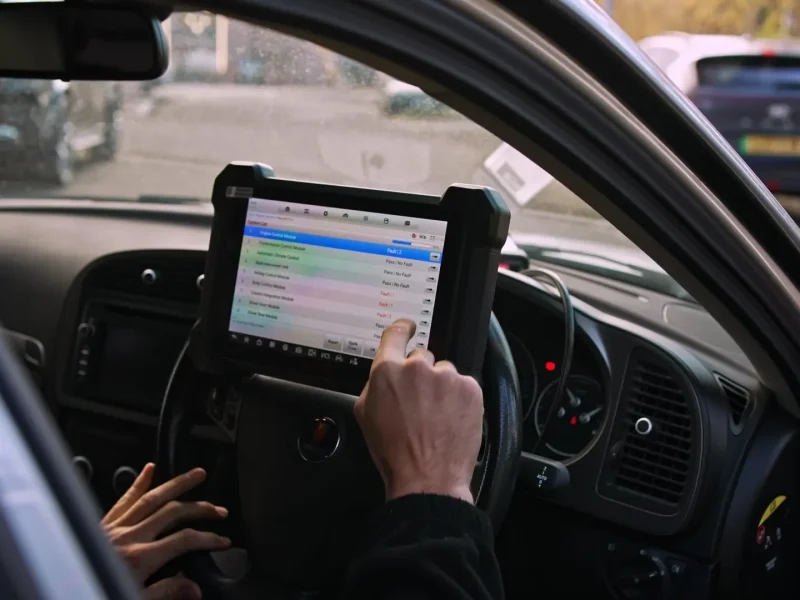
We connect to your Q5's OBD port and read the current ECU calibration. We then modify the EGR control maps to disable valve actuation and remove the associated monitoring routines from the software. The updated file is written back to the ECU. The whole process takes around 90 minutes.
Once complete, the ECU will not signal the EGR valve to operate and will not generate EGR-related fault codes. There is nothing to physically blank or cap. The valve remains in place; it simply receives no instruction and is not monitored.
We clear all stored EGR fault codes before we leave. If any other codes are present that are unrelated to the EGR, we will let you know.

Why software delete rather than physical removal
Physical EGR deletes involve blanking plates, removed pipework, and additional sealing. They work, but they introduce potential leak points and require the ECU to also be remapped to prevent fault codes anyway. Doing the software delete only is cleaner: fewer components disturbed, fewer potential issues, and the end result is the same. The ECU is the source of truth on the Q5, if the software says EGR is inactive and unfaulted, the car behaves accordingly.
We do not carry out physical removal as a standalone service. Software delete is the correct solution for the Q5 platform.
Booking
Call 0161 694 7331 with your registration and location. We work across a 40-mile radius of Eccles. The price is £220 regardless of whether you have the 2.0 TDI or 3.0 TDI, and regardless of which generation of Q5 you are running.